
- Introduction
- What Financial Sustainability Means in an Organizational Context
- Why Financial Sustainability Becomes More Important During Growth
- Key Factors That Influence Financial Sustainability
- Common Financial Challenges Faced by Growing Organizations
- Balancing Growth Ambitions With Financial Stability
- The Role of Financial Sustainability in Long-Term Planning
- Why Financial Sustainability Is a Continuous Process
- How Financial Sustainability Supports Organizational Confidence
- The Connection Between Financial Sustainability and Responsibility
- Conclusion
- Connect With Us

Introduction
As organizations grow, financial decisions become more complex. Early-stage success can sometimes create the illusion that growth alone is enough to ensure long-term stability. In reality, growth without financial sustainability often introduces new risks rather than reducing them.
Financial sustainability is about an organization’s ability to operate, adapt, and grow over time without placing continuous strain on its financial foundation. Understanding this concept helps organizations move beyond short-term gains and focus on stability that can support long-term objectives.
What Financial Sustainability Means in an Organizational Context
Financial sustainability refers to an organization’s ability to manage its financial resources in a way that supports ongoing operations, future commitments, and unexpected challenges. It is not limited to generating revenue or achieving profitability in isolated periods.
A financially sustainable organization maintains balance. Income aligns with expenses, obligations are anticipated rather than reacted to, and decisions are made with long-term implications in mind. This balance allows the organization to function with predictability instead of constant financial pressure.
Importantly, financial sustainability also includes flexibility. Markets change, costs fluctuate, and external conditions can shift unexpectedly. Organizations that are financially sustainable are better positioned to absorb these changes without severe disruption.
Why Financial Sustainability Becomes More Important During Growth

As organizations grow, financial complexity increases. What once worked for a small team or limited operation may no longer be sufficient at a larger scale. Growth introduces higher operating costs, more dependencies, and greater responsibility.
Expansion often requires investment in people, infrastructure, technology, and processes. Without careful planning, these investments can stretch financial capacity and reduce stability. This is why financial sustainability becomes increasingly important during periods of growth.
Growth without sustainability can lead to situations where organizations appear successful on the surface but struggle internally. In contrast, financially sustainable growth provides a stronger foundation that supports expansion without compromising stability.
Key Factors That Influence Financial Sustainability
Several interconnected factors influence an organization’s financial sustainability. One of the most significant is understanding cost structures. As organizations grow, costs do not always increase in a linear way. Fixed costs, variable expenses, and operational overhead can behave differently at scale.
Another important factor is clarity in financial decision-making. When decisions are made without a clear understanding of their financial impact, sustainability can erode over time. Responsible planning involves evaluating not only immediate costs but also long-term obligations.
Resource allocation also plays a critical role. Financial sustainability improves when resources are allocated deliberately rather than reactively. This includes evaluating priorities, managing trade-offs, and avoiding unnecessary financial strain.
Common Financial Challenges Faced by Growing Organizations

Growing organizations often encounter similar financial challenges, regardless of industry. One common challenge is overextension, where expansion happens faster than financial systems can support. This can create pressure on cash flow and increase reliance on short-term solutions.
Another challenge is limited financial visibility. As operations become more complex, it becomes harder to predict future financial needs without proper planning and review. This lack of visibility can lead to delayed responses when issues arise.
In addition, growing organizations may struggle with balancing immediate operational needs against long-term financial goals. When short-term demands dominate decision-making, sustainability can gradually weaken.
Balancing Growth Ambitions With Financial Stability
Ambition drives progress, but ambition without balance can introduce risk. Organizations often face decisions that require choosing between faster growth and financial caution. Finding the right balance is essential for sustainability.
Financial stability does not mean avoiding growth. Instead, it involves pacing growth in a way that aligns with financial capacity. This may require prioritizing certain initiatives while postponing others.
Balanced growth allows organizations to remain adaptable. When financial systems are stable, organizations can respond thoughtfully to opportunities rather than feeling pressured to act immediately. This approach supports confidence and consistency over time.
The Role of Financial Sustainability in Long-Term Planning
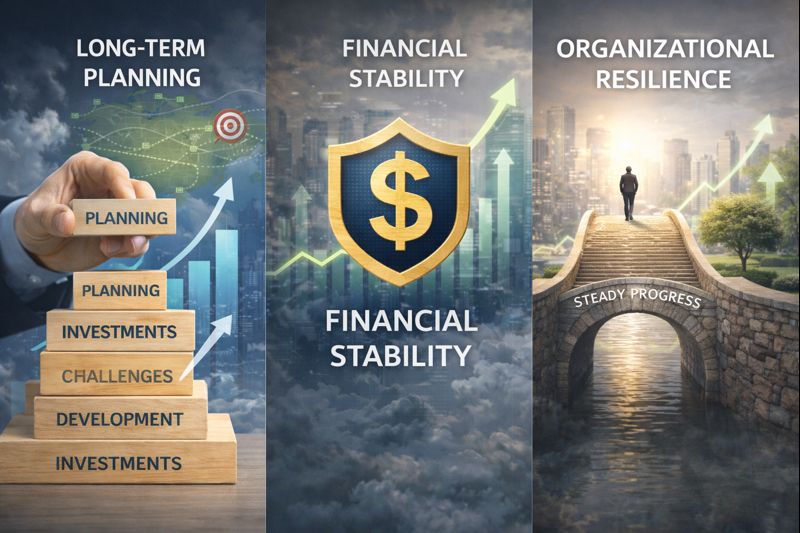
Financial sustainability supports long-term planning by providing clarity and predictability. When financial systems are stable, organizations can plan more effectively for future developments, investments, and challenges.
Long-term planning becomes more reliable when financial assumptions are realistic and grounded in actual capacity. This reduces the likelihood of sudden disruptions and allows organizations to adjust plans gradually as conditions change.
Over time, sustainable financial practices contribute to organizational resilience. They enable continuity even during periods of uncertainty or transition, supporting steady progress rather than abrupt shifts.
Why Financial Sustainability Is a Continuous Process
Financial sustainability is not a fixed achievement. It evolves as organizations grow, environments change, and priorities shift. What is sustainable at one stage may require adjustment at another.
Treating financial sustainability as an ongoing process encourages regular evaluation and refinement. This includes reviewing assumptions, monitoring financial health, and adapting strategies when necessary.
Organizations that view sustainability as continuous are better prepared for change. They remain aligned with long-term objectives while staying responsive to real-world conditions.
How Financial Sustainability Supports Organizational Confidence
When financial systems are stable, decision-making becomes more confident. Leaders can focus on strategy, people, and long-term goals rather than constantly addressing financial uncertainty.
This confidence extends beyond leadership. Teams operate more effectively when financial stress is reduced, and planning is clearer. Financial sustainability creates an environment where growth feels intentional rather than reactive.
Over time, this confidence contributes to stronger organizational culture and clearer direction.
The Connection Between Financial Sustainability and Responsibility
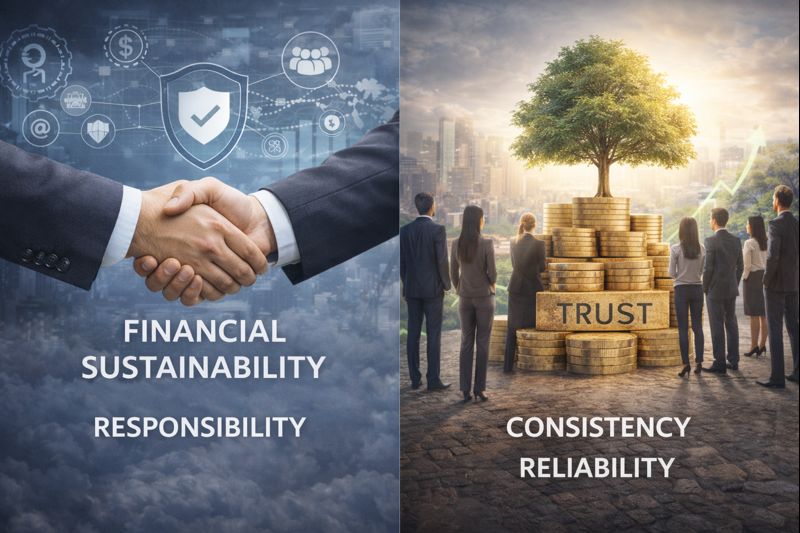
Financial sustainability also reflects responsibility. It demonstrates an organization’s commitment to operating within its means and respecting long-term obligations.
Responsible financial practices help organizations build trust with stakeholders, partners, and teams. This trust is built not through rapid expansion but through consistency and reliability.
Sustainability reinforces the idea that long-term stability is more valuable than short-lived success.
Conclusion
Understanding financial sustainability in growing organizations requires looking beyond immediate outcomes. It involves recognizing how financial decisions shape stability, resilience, and long-term potential.
By prioritizing financial sustainability, organizations can support growth while maintaining balance. This approach encourages thoughtful planning, responsible expansion, and adaptability over time.
In an environment where change is constant, financial sustainability remains a foundational element for organizations seeking continuity, confidence, and long-term strength.
Connect With Us
Sunwol Venture’s Social Handles
Atharv Shirke’s Social Handles
Email: sunwolventures06@gmail.com