

- Introduction
- What Is Agentic AI?
- How Agentic AI Differs from Traditional AI Systems
- Real-World Applications of Agentic AI
- Opportunities Created by Agentic AI
- Challenges and Considerations
- Why Agentic AI Signals a Structural Shift in Technology Design
- The Future Outlook for Agentic AI
- Agentic AI and Responsible Implementation
- Conclusion
- Connect with Us
Introduction
Artificial intelligence has rapidly moved from research labs into everyday tools. For many people, AI is now associated primarily with chatbots systems that generate text, answer questions, or assist with writing. While these tools are impressive, they represent only one stage in the evolution of AI.
A new phase is emerging: agentic AI. Unlike traditional AI systems that respond to prompts, agentic AI is designed to act with a degree of autonomy. It can plan, make decisions within defined boundaries, and execute multi-step tasks toward specific goals.
Understanding how agentic AI is shaping the future of technology requires looking beyond content generation and toward systems that actively participate in real-world processes.
What Is Agentic AI?

Agentic AI refers to artificial intelligence systems that operate as “agents.” Instead of simply producing outputs in response to a single request, these systems can:
- Set intermediate goals
- Evaluate options
- Make decisions
- Take actions
- Adjust based on feedback
In simple terms, traditional AI often reacts. Agentic AI, within defined limits, acts.
For example, a generative AI chatbot might draft an email when prompted. An agentic AI system, however, could analyze incoming emails, prioritize them, draft responses, schedule follow-ups, and notify users of critical items all within a structured workflow.
This shift from reactive assistance to semi-autonomous execution marks a significant step in technological development.
How Agentic AI Differs from Traditional AI Systems
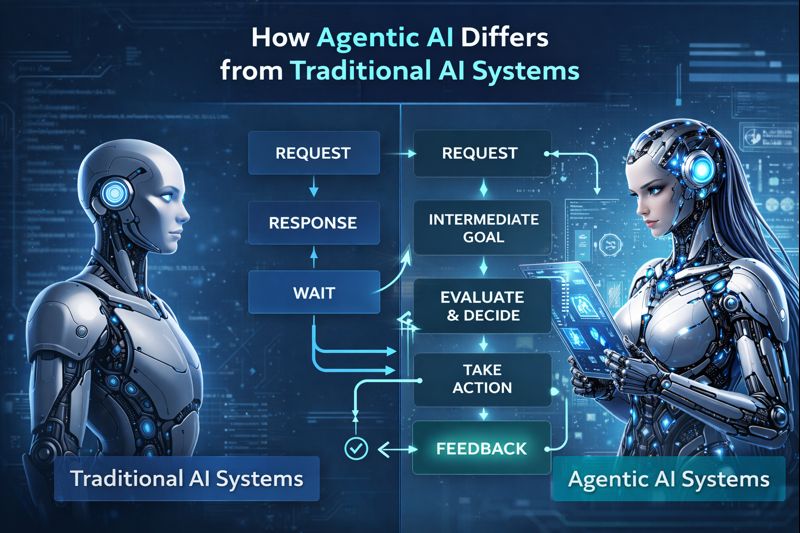
To understand the importance of agentic AI, it helps to compare it with earlier AI systems.
Traditional AI models, including many large language models, are primarily designed for prediction and generation. They analyze input data and generate responses based on learned patterns. While powerful, they typically require continuous human prompting.
Agentic AI systems introduce additional layers:
1. Multi-Step Reasoning
Instead of solving a single task, they break problems into smaller components and handle them sequentially.
2. Decision Loops
They evaluate outcomes and adjust actions accordingly.
3. Tool Integration
They can connect with external tools, databases, and APIs to complete tasks beyond simple text generation.
This architectural difference allows agentic AI to function more like a digital collaborator rather than a standalone tool.
Real-World Applications of Agentic AI
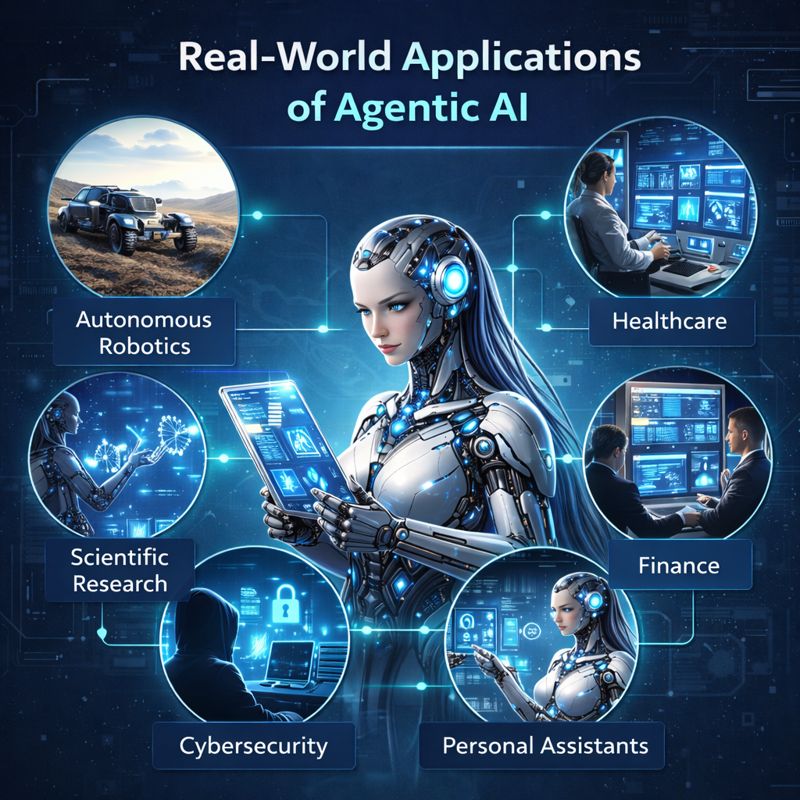
Although still evolving, agentic AI is already influencing several areas of technology.
1. Workflow Automation
Organizations are experimenting with AI agents that manage internal processes, such as organizing data, updating systems, or coordinating tasks across departments.
2. Research Assistance
Some systems can gather information from multiple sources, synthesize findings, and generate structured reports with minimal human intervention.
3. Cybersecurity Monitoring
Agentic AI can continuously monitor networks, detect anomalies, and initiate predefined defensive actions before escalating to human teams.
4. Logistics and Operations
In supply chain environments, AI agents can adjust delivery routes, manage inventory predictions, and respond dynamically to disruptions.
In each case, the system is not merely providing information it is executing tasks within defined parameters.
Opportunities Created by Agentic AI
The rise of agentic AI introduces several opportunities for organizations and developers.
1. Increased Efficiency
By automating multi-step processes, agentic AI can reduce repetitive manual tasks and free up time for higher-level decision-making.
2. Adaptability
These systems can adjust actions based on new information, making them useful in dynamic environments.
3. Scalable Support
Once properly designed, AI agents can operate continuously without fatigue, supporting operations at larger scales.
However, efficiency gains are only meaningful when paired with responsible oversight. Agentic AI must function within clear constraints to maintain reliability and accountability.
Challenges and Considerations

While the potential of agentic AI is significant, it also introduces important considerations.
1. Oversight and Governance
Autonomous systems must operate within clearly defined boundaries. Organizations need governance frameworks that determine what decisions AI agents can make independently.
2. Reliability
Multi-step execution increases complexity. Small errors can compound if not carefully monitored.
3. Security Risks
Systems that integrate with multiple tools and platforms may introduce new vulnerabilities if not secured properly.
4. Ethical Boundaries
Questions around accountability, transparency, and decision-making authority become more important as AI systems gain autonomy.
Addressing these challenges requires thoughtful system design rather than rapid deployment.
Why Agentic AI Signals a Structural Shift in Technology Design
The emergence of agentic AI reflects a broader structural shift in how technology systems are designed.
In earlier stages of digital transformation, software tools required direct human control at every step. The next phase introduces systems capable of limited independence within structured environments.
This shift changes architectural priorities. Developers must now consider:
- How agents access and process information
- How decision loops are validated
- How systems scale responsibly
- How human oversight is maintained
The conversation moves from “What can AI generate?” to “How should AI operate within complex systems?”
That transition represents a deeper transformation in technological thinking.
The Future Outlook for Agentic AI

Agentic AI is unlikely to replace human decision-making entirely. Instead, its role will likely expand gradually in areas where structured, repeatable tasks can benefit from automation.
Future developments may include:
- Improved reasoning frameworks
- Stronger human-in-the-loop systems
- Clearer regulatory standards
- More transparent AI architectures
As adoption grows, organizations will need to balance innovation with responsibility. Thoughtful integration, rather than rapid expansion, will determine long-term success.
Agentic AI and Responsible Implementation
The long-term impact of agentic AI depends less on capability and more on implementation. Systems that operate autonomously must remain aligned with organizational goals and ethical standards.
Responsible implementation includes:
- Clear operational limits
- Continuous monitoring
- Transparent decision processes
- Regular evaluation and refinement
When these principles guide development, agentic AI can enhance efficiency without compromising stability.
Conclusion
Agentic AI represents an evolution in how artificial intelligence interacts with real-world systems. Moving beyond chatbots and content generation, it introduces structured autonomy — the ability to plan, decide, and execute tasks within defined parameters.
Understanding agentic AI helps clarify the direction technology is taking. It signals a transition from tools that assist to systems that actively participate in workflows and operations.
As with any technological advancement, its long-term value will depend on careful design, responsible governance, and thoughtful integration into existing systems. When approached with balance and clarity, agentic AI has the potential to reshape how organizations think about automation and intelligent systems in the years ahead.