
- Introduction
- What Scaling Really Means in Technology Systems
- Key Factors That Influence Technology Systems Scaling
- Common Challenges That Appear as Systems Grow
- Why Real-World Conditions Matter
- The Role of Scalability in Long-Term Technology Planning
- How Teams Can Approach Scaling More Thoughtfully
- Conclusion
- Connect with us
Introduction
When people talk about scaling technology, the conversation often revolves around growth more users, more data, more features. But in real-world situations, scaling is rarely that simple. What works smoothly at a small scale can start to show cracks as demand increases.
Technology systems scaling is about preparing systems to grow without losing stability, performance, or reliability. Understanding how this works in real-world conditions helps teams build technology that lasts, rather than systems that struggle once they gain momentum.

What Scaling Really Means in Technology Systems
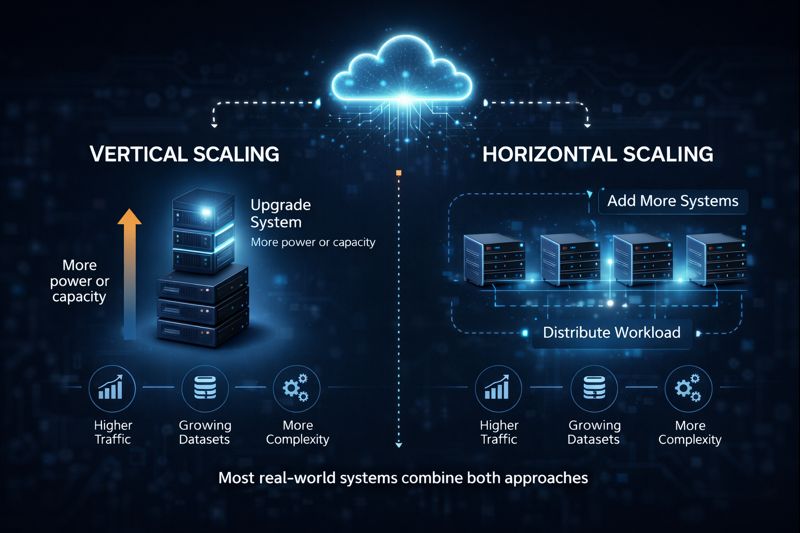
At its core, scaling refers to a system’s ability to handle increasing demand while continuing to function as expected. This demand may come from higher traffic, growing datasets, or more complex operations.
There are two commonly used approaches to scaling:
- Vertical scaling, where existing systems are upgraded with more power or capacity
- Horizontal scaling, where workloads are shared across multiple systems
In practice, most real-world systems rely on a thoughtful mix of both approaches rather than choosing just one.
Key Factors That Influence Technology Systems Scaling
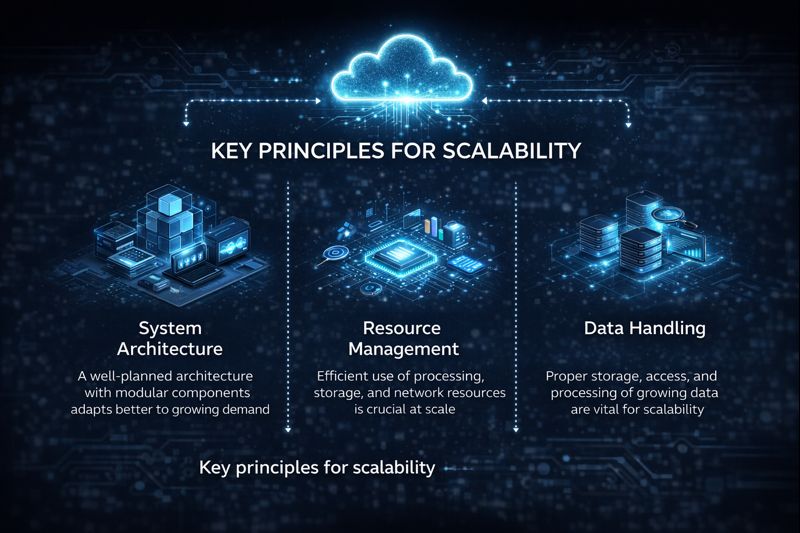
Several practical factors determine how well a technology system can scale over time.
System Architecture
A well-planned architecture makes scaling easier. Systems built with modular components tend to adapt better as demand grows, since individual parts can evolve without affecting the entire system.
Resource Management
How efficiently a system uses processing power, storage, and network resources becomes increasingly important as scale increases. Poor resource planning often leads to performance issues when systems are under pressure.
Data Handling
As data volumes grow, the way information is stored, accessed, and processed plays a major role in scalability. Small inefficiencies that go unnoticed early can become serious problems later.
Common Challenges That Appear as Systems Grow
Scaling introduces challenges that are not always obvious during early development. Many systems perform well initially but begin to struggle once real-world usage increases.
Some common issues include:
- Slower performance during peak usage
- Increased system complexity
- Higher maintenance and operational effort
- Difficulty identifying and fixing issues quickly
These challenges highlight why scalability should be considered from the beginning, rather than treated as a problem to solve later.

Why Real-World Conditions Matter
Technology systems rarely operate in perfect or predictable environments. User behavior changes, demand fluctuates, and external dependencies can fail without warning.
Systems that scale successfully are designed with these realities in mind. They account for:
- Sudden spikes in usage
- Partial failures and recovery
- Long-term maintenance and updates
Ignoring real-world conditions often results in systems that appear strong at first but struggle as complexity increases.
The Role of Scalability in Long-Term Technology Planning
Scalability is not just a technical concern, it is a long-term planning decision. Systems that are designed to scale reduce the need for frequent rebuilds and help teams respond more calmly to growth.
By prioritizing scalability, organizations can:
- Support steady expansion
- Maintain a consistent user experience
- Reduce operational stress over time
This approach allows technology to grow alongside real-world needs rather than constantly lag behind them.

How Teams Can Approach Scaling More Thoughtfully
One of the most common mistakes teams make is treating scalability as something to address only after problems appear. In reality, thoughtful scaling is less about reacting to growth and more about preparing for it in advance.
A practical approach to scaling starts with asking the right questions early:
- How might usage change over time?
- Which parts of the system are most likely to experience stress?
- What assumptions are being made about user behavior or data growth?
Rather than overengineering from the beginning, successful teams focus on building systems that can adapt gradually. This includes documenting design decisions, monitoring system behavior as it evolves, and being willing to refine architecture when real-world usage reveals new patterns.
By viewing scaling as an ongoing process instead of a one-time solution, teams can make more balanced decisions that support both growth and stability.

Conclusion
Understanding how technology systems scale in the real world requires a practical mindset. It involves anticipating growth, recognizing limitations, and designing systems that can adapt as conditions change.
Scalable technology is built through thoughtful design, ongoing evaluation, and respect for real-world complexity. As systems continue to evolve, scalability remains one of the most important foundations for building technology that is reliable, resilient, and ready for the future.
Connect with us
Sunwol Venture’s Social Handles
Atharv Shirke’s Social Handles
Email: sunwolventures06@gmail.com